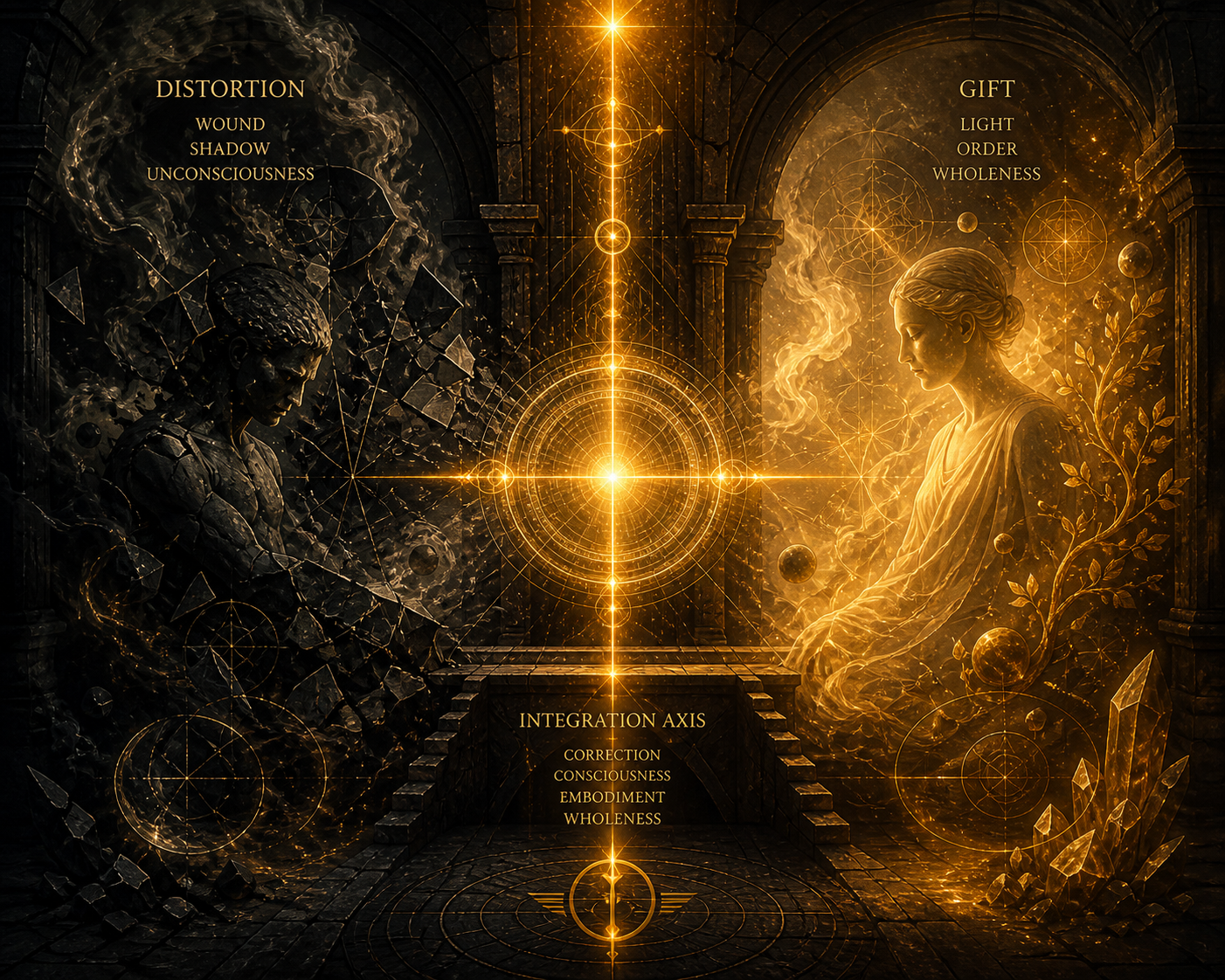
An Integration Axis is the central bridge between a person’s gift and distortion. It shows where a number, archetype, placement, name current, or life path can split into shadow or mature into wholeness. In the Archive, the Integration Axis helps translate raw symbolic information into correction, embodiment, and conscious development.
The Archive uses the term Integration Axis to describe one of the most important movements in the entire system.
An Integration Axis is the bridge between what something is, how it distorts, and how it becomes whole.
It is not enough to know a number. It is not enough to know a placement. It is not enough to know an archetype. It is not enough to know a wound.
The deeper question is:
How does this pattern become integrated?
The Integration Axis answers that question.
It shows the path between raw potential and conscious embodiment. It reveals how a gift can become distorted, how distortion can become correction, and how correction can become mature expression.
In the Archive, the Integration Axis is used to prevent symbolic systems from becoming static labels.
A number is not just a number. A placement is not just a placement. A wound is not just a wound. A gift is not just a gift.
Every pattern has a direction of descent or ascent.
It can fall into shadow. It can rise into maturity. It can remain unconscious. It can become integrated.
The Integration Axis is the line between those possibilities.
⸻
The Basic Formula
The simplest formula is:
Gift → Distortion → Correction → Integration
A person may begin with a gift, but if that gift is unconscious, wounded, exaggerated, repressed, or misused, it can distort.
The distortion is not the opposite of the gift.
It is often the gift under pressure.
For example:
Expression can distort into performance. Sensitivity can distort into emotional dependency. Discipline can distort into rigidity. Power can distort into control. Love can distort into attachment. Wisdom can distort into isolation. Freedom can distort into avoidance. Compassion can distort into self-erasure.
The Integration Axis identifies this movement.
It asks:
What is the original gift? How does it distort when unconscious? What correction brings it back into alignment? What does mature embodiment look like?
This is the reason the Archive’s systems are not just descriptive.
They are corrective.
⸻
Why the Integration Axis Matters
Without an Integration Axis, symbolic interpretation becomes incomplete.
A reading may tell someone they are creative, sensitive, powerful, intuitive, disciplined, or visionary. But if the reading does not show how that quality distorts and how it can be corrected, it leaves the person with information but not transformation.
The Archive is designed to move beyond information.
The purpose is not only to describe the person.
The purpose is to help the person become whole.
This means every major pattern must be read through its axis of integration.
A person should be able to see:
What is the gift? Where is the wound? Where is the distortion? What is the correction? What does maturity look like? How does this become embodied?
The Integration Axis turns the reading into a path.
⸻
Integration Axis in Numerology
In numerology, the Integration Axis reveals how each number carries both a gift and a distortion.
A Life Path 1 may carry the gift of sovereignty, leadership, and origin. But under distortion, that same current can become pride, isolation, domination, or false selfhood. The Integration Axis teaches the 1 to move from egoic assertion into aligned identity.
A Life Path 2 may carry the gift of sensitivity, receptivity, and relational awareness. But under distortion, it can become dependency, emotional confusion, fear, or passivity. The Integration Axis teaches the 2 to move from unconscious absorption into conscious receptivity.
A Life Path 3 may carry the gift of expression, creativity, teaching, and articulation. But under distortion, it can become performance, scattering, exaggeration, or avoidance through entertainment. The Integration Axis teaches the 3 to move from expression as release into expression as truth.
A Life Path 4 may carry the gift of structure, verification, and system-building. But under distortion, it can become rigidity, anxiety, obsession, or imprisonment by form. The Integration Axis teaches the 4 to move from control into living architecture.
A Life Path 5 may carry the gift of movement, adaptation, and communication. But under distortion, it can become restlessness, impulsivity, escapism, or inconsistency. The Integration Axis teaches the 5 to move from motion into mastery.
A Life Path 6 may carry the gift of love, harmony, embodiment, and responsibility. But under distortion, it can become attachment, image management, people-pleasing, or comfort addiction. The Integration Axis teaches the 6 to move from pleasing into embodied value.
A Life Path 7 may carry the gift of wisdom, contemplation, mystery, and spiritual refinement. But under distortion, it can become isolation, suspicion, dissociation, or spiritual avoidance. The Integration Axis teaches the 7 to move from withdrawal into integrated wisdom.
A Life Path 8 may carry the gift of power, stewardship, manifestation, and consequence. But under distortion, it can become domination, material obsession, fear of weakness, or misuse of authority. The Integration Axis teaches the 8 to move from control into righteous stewardship.
A Life Path 9 may carry the gift of compassion, completion, universality, and sacred release. But under distortion, it can become martyrdom, savior complex, emotional exhaustion, or grief-identification. The Integration Axis teaches the 9 to move from sacrifice into conscious completion.
In this way, every number has an axis.
The number is not interpreted only by its positive meaning.
It is interpreted by its full movement from gift to shadow to correction to embodiment.
⸻
Integration Axis in LPECA
LPECA depends heavily on the Integration Axis because LPECA is not simply a calculation of numbers.
It is a circuit analysis.
LPECA compares the Life Path and Expression Path to understand how a person’s developmental road interacts with their name current, expression function, and visible identity.
The Integration Axis helps LPECA answer:
Where do the Life Path and Expression Path harmonize? Where do they create tension? Where does the name current support the life path? Where does the name current distort the life path? Where is the person overusing one number and neglecting another? What correction allows the circuit to become whole?
Without the Integration Axis, LPECA would only say what numbers are present.
With the Integration Axis, LPECA can show how the numbers work together, where they conflict, and how the person can embody them more consciously.
This is the difference between a reading and a system of transformation.
⸻
Integration Axis in LPICA
LPICA uses the Integration Axis to deepen the interpretation of the Life Path current.
The Life Path is not merely a destiny label.
It is a developmental current.
LPICA asks how that current is being lived.
Is the person living the gift? Are they trapped in the distortion? Are they aware of the correction? Are they embodying the mature form? Are they repeating the same life path wound unconsciously?
The Integration Axis allows LPICA to read the Life Path as a living process.
For example, a person may have a 4 current. A shallow interpretation may say they are practical, disciplined, or structured. But the Integration Axis asks whether their structure is alive or fear-based. It asks whether they are building from truth or trying to control reality because they do not feel safe.
That question changes the reading.
It moves from description to diagnosis.
Then it moves from diagnosis to correction.
⸻
Integration Axis in APEA
APEA uses the Integration Axis to read archetypal and expression patterns.
An archetype does not only have a bright side.
Every archetype has a shadow.
The Lion can become noble sovereignty, but it can also become pride. The Fox can become intelligence and strategy, but it can also become manipulation. The Deer can become sensitivity and grace, but it can also become fragility or avoidance. The Eagle can become vision and command, but it can also become distance and superiority. The Wolf can become loyalty and instinct, but it can also become exile, hunger, or pack-wound.
The Integration Axis shows how an archetype matures.
It prevents the user from identifying only with the flattering side of the symbol.
This is crucial because people often choose symbols that reveal not only what they are, but what they are trying to become, protect, compensate for, or recover.
The Integration Axis helps separate embodiment from aspiration.
It asks:
Is this archetype embodied? Is it compensatory? Is it defensive? Is it aspirational? Is it mature? Is it distorted? What correction would bring it into wholeness?
This is how APEA and ARA become more than symbolic personality systems.
They become diagnostic mirrors.
⸻
Integration Axis in the Future Integration Engine
The future Integration Engine will use the Integration Axis to read anima, animus, Mars, Venus, projection, relational mirroring, and inner polarity.
In that system, the Integration Axis will be especially important because relationships often reveal split-off parts of the self.
A person may project their unlived Mars onto another person. A person may project their unlived Venus onto another person. A person may confuse attraction with integration. A person may chase in another person what they have not yet developed within themselves.
The Integration Axis helps the user ask:
What am I projecting? What am I avoiding? What am I trying to integrate through this attraction? What part of myself is being mirrored back to me? What would it mean to embody this quality directly?
This prevents relationship analysis from becoming shallow compatibility scoring.
The Archive does not reduce relationship to “good match” or “bad match.”
It reads relationship as an individuation field.
The Integration Axis shows what the relationship is trying to make conscious.
⸻
Integration Is Not Suppression
Integration does not mean suppressing the shadow.
It does not mean pretending distortion is not present.
It does not mean forcing a person to become balanced in a flat or lifeless way.
Integration means the pattern is brought into relationship with consciousness.
The raw force is not destroyed.
It is refined.
Anger becomes courage. Fear becomes discernment. Sensitivity becomes perception. Power becomes stewardship. Grief becomes compassion. Desire becomes devotion. Isolation becomes wisdom. Expression becomes truth.
The Integration Axis preserves the original energy while correcting its misuse.
This is important.
The Archive does not try to erase intensity.
It tries to return intensity to its proper function.
⸻
Shadow Pattern
The primary shadow of the Integration Axis is identification with only one side of the pattern.
A person may identify only with the gift and refuse to see the distortion.
This creates spiritual pride, self-deception, or unconscious repetition.
A person may identify only with the wound and refuse to see the gift.
This creates shame, helplessness, or collapse.
A person may identify only with correction and become harsh, perfectionistic, or self-punishing.
This creates spiritual rigidity.
A person may chase integration as an idea but avoid embodiment.
This creates endless analysis without transformation.
The Integration Axis requires the whole movement.
Gift must be seen. Distortion must be named. Correction must be practiced. Integration must be lived.
⸻
Correction Protocol
To apply the Integration Axis, use these questions:
What is the original gift in this pattern? How does this gift distort under fear, pressure, pride, pain, or unconsciousness? What wound may be feeding the distortion? What correction restores the gift to proper function? What does the mature version look like in daily life? What action would embody this integration now?
The final question matters most.
Integration is not complete until it becomes lived.
A person has not integrated power until power becomes stewardship. A person has not integrated love until love becomes truth and care. A person has not integrated wisdom until wisdom becomes embodied discernment. A person has not integrated expression until expression becomes honest function.
The Integration Axis always ends in embodiment.
⸻
Final Doctrine Statement
An Integration Axis is the bridge between gift, distortion, correction, and wholeness.
It shows how a number, archetype, placement, name current, wound, or relational pattern can either fall into shadow or mature into conscious embodiment.
The Archive uses the Integration Axis because symbolic systems should not only identify people.
They should help people become whole.
A gift without correction can distort.
A wound without meaning can collapse.
A shadow without integration can repeat.
A reading without an Integration Axis can inform the mind while leaving the life unchanged.
The Integration Axis turns symbolic knowledge into a path of transformation.
It asks not only:
What does this mean?
But also:
How does this become whole?
This is why the Integration Axis is foundational to LPECA, LPICA, APEA, ARA, and the future Integration Engine.
It is one of the Archive’s central bridges between diagnosis and embodiment.