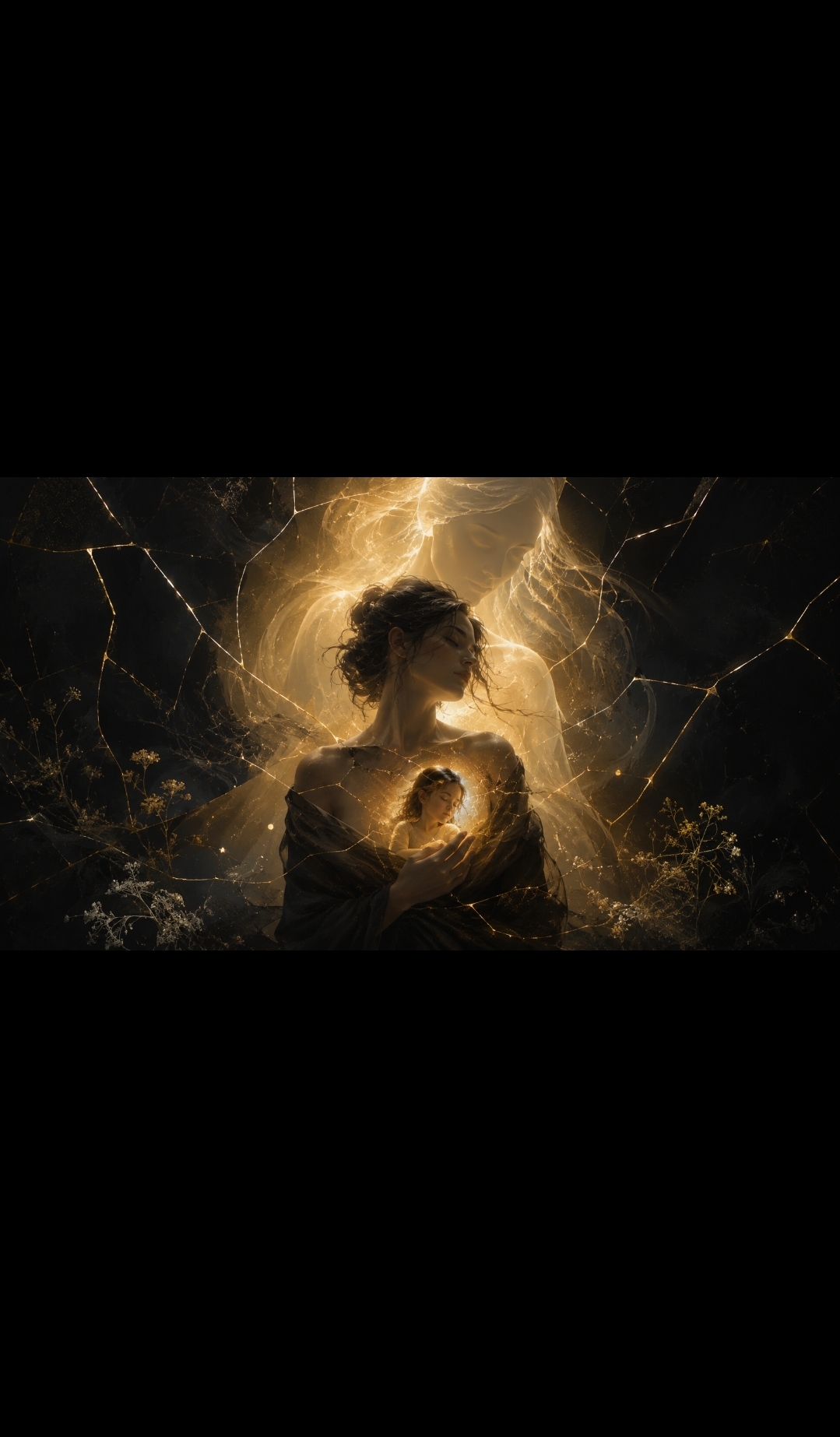
The mother wound is not only a personal pain. It is a distortion in the early field of safety, tenderness, receptivity, and belonging. When unhealed, it shapes the way a person loves, receives, attaches, performs, withdraws, and searches for completion through others. True healing begins when the forgotten self is recovered, not through blame, but through conscious love, correction, and spiritual re-integration.
The mother wound is one of the deepest formative wounds because it touches the earliest layer of embodiment. The child does not first know itself as an independent mind. The child first experiences itself through the field that holds it. The mother, or the maternal figure, becomes the first mirror of existence. Through that mirror the child receives an unconscious answer to foundational questions: Am I safe? Am I wanted? Am I allowed to need? Am I too much? Am I seen? Am I lovable when I am weak? Am I protected when I cannot protect myself? When the maternal field is stable, warm, responsive, and grounded, the child learns that existence is permitted. The nervous system relaxes into life. The emotions begin to organize around trust. The body learns that it does not have to constantly brace against abandonment, rejection, intrusion, or emotional unpredictability. When the maternal field is wounded, the child often adapts before it understands. This adaptation may look like performance, silence, hyper-independence, caretaking, emotional self-erasure, rebellion, dissociation, perfectionism, or desperate attachment. These adaptations are not character flaws. They are early survival strategies. The mother wound can express through absence. This may be physical absence, emotional absence, spiritual absence, or the absence of attuned tenderness. A mother can be present in the room but absent in the heart. A child can be fed, clothed, and externally cared for while still starving for recognition, softness, and emotional reflection. The wound can also express through intrusion. Some maternal fields do not abandon the child outwardly but consume the child inwardly. The child becomes an extension of the mother’s unmet needs, fears, projections, or identity. In this form, the child may feel loved only when compliant, useful, impressive, loyal, emotionally available, or easy to control. The child is not received as a separate soul but used as a stabilizer for the parent’s unresolved inner life. Both absence and intrusion produce distortion. In absence, the child may believe love must be chased. In intrusion, the child may believe love requires self-abandonment. In both cases, love becomes entangled with survival. As the person matures, the mother wound often reappears through romantic relationships, friendships, spiritual seeking, creative expression, body image, sexuality, and the ability to receive support. The person may search for the lost maternal field in partners, mentors, communities, audiences, or spiritual systems. They may unconsciously ask others to finally give them what was not given early enough: safety, approval, delight, protection, warmth, permission, and unconditional belonging. This is where projection begins. Projection is not simply fantasy. Projection is the psyche’s attempt to locate an exiled part of itself outside itself. When the forgotten self has not been recovered, another person may appear to carry the missing piece. The beloved becomes the mother, the rescuer, the witness, the lost home, the divine container. The person then mistakes emotional activation for destiny, attachment hunger for love, and familiarity for truth. Conscious love requires a different movement. Conscious love does not deny longing, but it refuses to make another person responsible for repairing the original wound. It recognizes that attraction often reveals unfinished inner material. It asks: What part of me am I seeking through this person? What early hunger is being awakened? What did I never receive that I am now demanding from love? What self did I bury in order to survive? The forgotten self is the part of the person that existed before adaptation became necessary. It is the spontaneous self, the soft self, the expressive self, the needy self, the playful self, the trusting self, the intuitive self, the creative self, the self that did not yet know it had to earn tenderness. The mother wound hides this self beneath protective structures. Some people protect the forgotten self through hardness. They become untouchable, self-sufficient, sharp, productive, emotionally controlled, or suspicious of tenderness. Others protect it through overexposure. They give too much, attach too quickly, confess too soon, merge too deeply, or become emotionally dependent on being chosen. Both patterns are forms of defense. The path of healing requires neither blaming the mother endlessly nor excusing the wound prematurely. Blame can keep the soul tied to the wound. Premature forgiveness can bury the truth before it has been metabolized. The correction path requires truthful recognition, grief, separation, re-mothering, and spiritual integration. Truthful recognition means naming what happened without minimizing it. If there was absence, call it absence. If there was emotional coldness, call it emotional coldness. If there was manipulation, call it manipulation. If there was instability, call it instability. The soul cannot heal what the conscious mind refuses to name. Grief is the next gate. Many people avoid grief because grief feels like collapse. But grief is often the first honest movement of the real self returning. The person must grieve not only what happened, but what did not happen. They must grieve the childhood they organized themselves around not having. They must grieve the tenderness they deserved but did not receive. They must grieve the version of themselves that had to disappear. Separation follows grief. This does not always mean physical distance, though sometimes it does. More deeply, separation means the person stops identifying with the wound as destiny. They begin to say: This pain came through my beginning, but it is not the totality of my being. My mother’s wound is not my name. My childhood adaptation is not my final self. My longing is real, but it does not have to rule me. Re-mothering is the conscious restoration of the inner maternal principle. This includes learning to speak inwardly with patience, to nourish the body, to regulate the nervous system, to protect vulnerability, to allow rest, to create beauty, to receive support, and to stop treating need as shame. Re-mothering is not indulgence. It is disciplined tenderness. Spiritual integration completes the correction. The human mother is not the final source of being. The maternal field is an earthly vessel, and like all vessels, it can be cracked, limited, distorted, or wounded. Healing deepens when the person realizes that the ultimate source of love, order, protection, and belonging must come from God. The earthly wound is real, but it is not ultimate. The soul must return to divine origin, not merely psychological repair. This is why conscious love matters. When love becomes conscious, it no longer functions as a battlefield for old wounds. It becomes a mirror, a refinement field, and a place of responsibility. Conscious love does not say, “You must become the mother I never had.” It says, “You are awakening the place where I was not loved correctly, and I will meet that place with truth rather than possession.” The mother wound is healed when the person can receive without panic, need without shame, love without collapse, separate without terror, and care without self-erasure. It is healed when tenderness no longer feels dangerous. It is healed when the forgotten self returns from exile and is no longer forced to perform, hide, chase, or defend its right to exist. The final movement is not resentment. It is recovery. The person recovers their softness without losing discernment. They recover their need without becoming dependent. They recover their independence without becoming cold. They recover their love without surrendering their soul. They become capable of being held by God, by truth, by their own mature inner structure, and by human love that is no longer asked to replace the original wound.