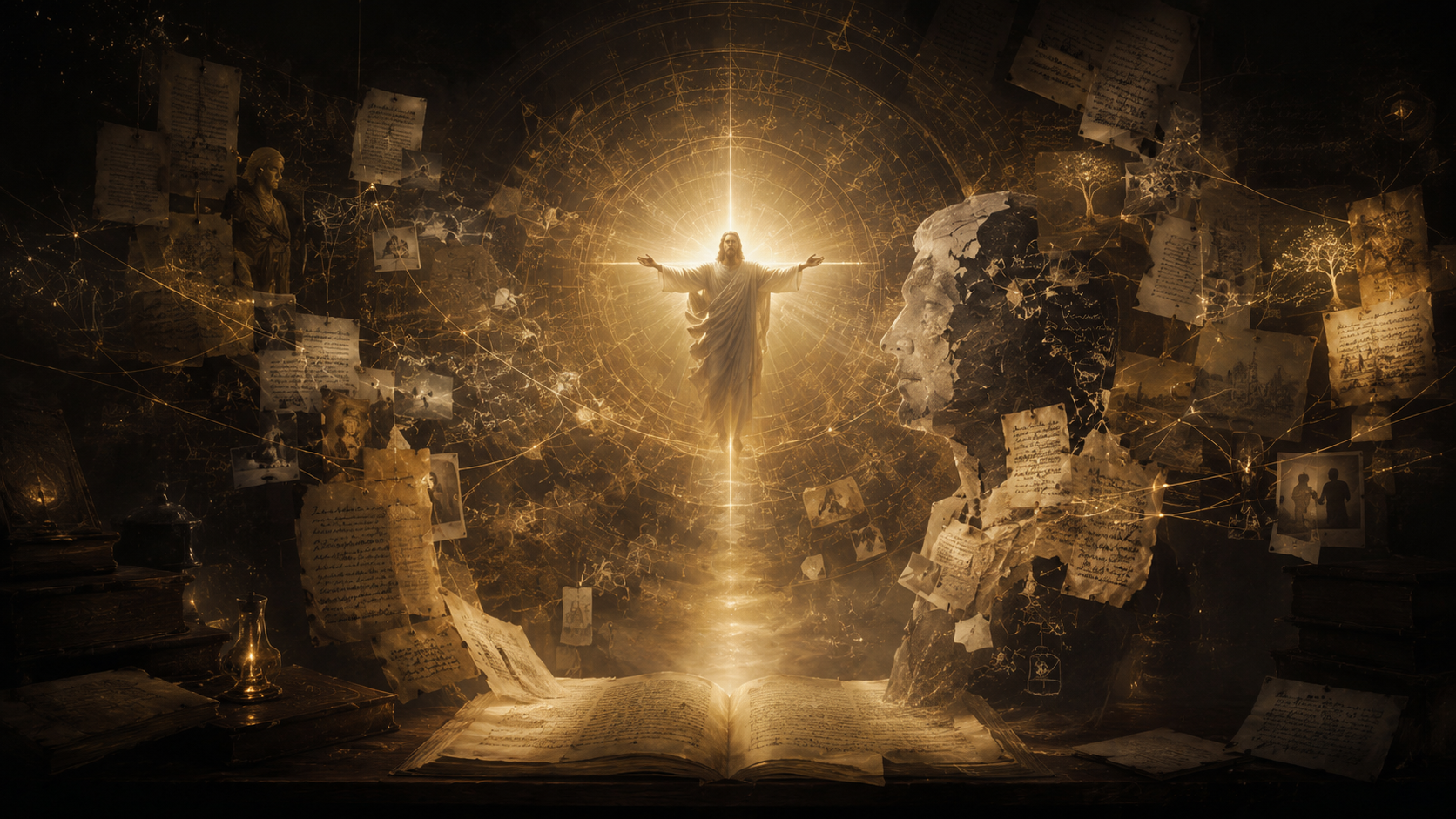
Memory is not only the storage of the past. Memory is the continuity of the self. When truth is abandoned, the inner life fragments; when truth is restored, identity begins to cohere again. Christ, as the living axiom of Truth, becomes the center through which remembrance, conscience, and selfhood are made whole.
Christ as the Axiom of Truth: Memory, Identity, and the Continuity of the Self
There is a deep relationship between truth, memory, and identity.
Memory is not merely the mind’s ability to store information. It is not only a record of events, facts, names, dates, wounds, or experiences. Memory is one of the structures by which the self remains continuous. Through memory, a person knows, “This is what happened. This is who I was. This is what I learned. This is what I must not forget. This is what I must now become.”
When memory is coherent, identity can remain coherent. When memory is scattered, denied, distorted, or buried beneath self-deception, identity becomes unstable. The person may still function, speak, work, perform, and survive, but inwardly there can be a rupture. The self becomes divided between what happened, what was denied, what was invented, what was suppressed, and what has not yet been brought into truth.
This is why truth is not merely a moral preference. Truth is structural.
Truth is the architecture of continuity.
And in the Christian mystery, Christ is not simply a teacher of truth, a speaker of truth, or an example of truth. Christ is Truth itself. Christ is the living axiom by which all lesser truths are judged, corrected, purified, and restored.
An axiom is a first principle. It is a foundational truth that does not depend on another truth beneath it to be valid. It is the ground from which other reasoning proceeds. If the axiom is false, everything built upon it becomes unstable. If the axiom is true, then everything built in alignment with it can become ordered.
To say that Christ is the axiom of Truth means that Christ is the living center of reality’s moral, spiritual, and ontological order. He is not simply one belief among others. He is the measure by which falsehood is exposed, fragmentation is healed, memory is purified, and the self is brought back into coherence.
In Scripture, Christ says, “I am the way, and the truth, and the life.” This is not a decorative statement. It is a metaphysical declaration. Truth is not presented as an abstraction separate from God. Truth is personal. Truth has a face. Truth has a voice. Truth has a body. Truth enters history, suffers under false accusation, descends into death, and rises without corruption.
In Christ, truth is not merely accuracy.
Truth is life.
This matters because the human self cannot remain whole while living in contradiction to truth. A person may survive contradiction. A person may adapt to contradiction. A person may become skilled at explaining contradiction. But contradiction still divides the inner life.
Falsehood creates fractures.
Sometimes those falsehoods are intentional. A person lies, hides, manipulates, performs, or refuses to admit what is real. But sometimes the falsehood is defensive. Trauma, fear, shame, rejection, or survival pressure can cause a person to conceal reality even from themselves. This distinction matters deeply. The purpose of this teaching is not to condemn the wounded person. It is not to say that every fragmented memory is moral failure. Trauma can disrupt memory involuntarily. The nervous system can hide what the soul was not ready to carry. The mind can protect itself through partial remembrance.
But even then, healing eventually requires truth.
Not truth as accusation.
Truth as restoration.
Not truth as punishment.
Truth as return.
When a person lies to themselves long enough, they begin to lose access to the original thread of their own being. The lie may begin as protection, but over time it can become a false architecture. The self has to keep arranging itself around the thing it refuses to name. Energy is spent maintaining the false version of events. Memory becomes edited. Emotion becomes displaced. The body may carry what the conscious mind refuses to speak. Relationships become distorted because the person is no longer relating from the whole self, but from a defended self.
This is one reason truth sets free.
Truth restores movement where falsehood created paralysis.
Truth restores continuity where denial created fragmentation.
Truth restores identity where shame created exile.
To remember truthfully is not merely to recall the past. It is to recover the self from distortion. It is to gather the scattered fragments of experience and bring them under the authority of what is real. This is why confession, repentance, testimony, and remembrance are so central to spiritual life. They are not only religious behaviors. They are acts of reintegration.
Confession says: I will no longer split myself from what is true.
Repentance says: I will no longer build my life around what is false.
Testimony says: I will remember what God has done without letting pain rewrite the story.
Remembrance says: I will preserve the continuity of my soul before God.
When Christ becomes the axiom of truth within a person, the inner life begins to reorder. The person no longer has to invent a self to survive. The person no longer has to defend a false image. The person no longer has to live as a collection of fragments competing for control. The truth of Christ becomes the central flame by which all things are examined.
What is false must be named.
What is wounded must be brought into mercy.
What is hidden must be brought into light.
What is divided must be gathered.
What is dead must be raised.
This is the deeper meaning of spiritual memory. To remember rightly is to remember in God. It is to let the past be seen through truth rather than distortion. It is to allow pain to be acknowledged without allowing pain to become the final author of identity.
A person is not only what happened to them.
A person is not only what they did.
A person is not only what they lost.
A person is not only what they became in order to survive.
A person is most deeply what God knows them to be, and that knowing is not vague. It is precise. It is truthful. God does not heal by pretending. God heals by revealing reality in a form the soul can finally bear.
This is why Christ is both Truth and Savior. If truth came without mercy, it would crush the wounded. If mercy came without truth, it would leave the wound unnamed. Christ brings both. He does not flatter the false self, but neither does He abandon the broken self. He exposes in order to restore. He corrects in order to redeem. He remembers the person beneath the distortion.
The continuity of the self depends on this restoration.
Without truth, memory becomes unstable. Without memory, identity becomes unstable. Without identity, the will becomes unstable. Without the will, a person becomes vulnerable to every impulse, projection, fear, and external influence. The human being becomes reactive rather than rooted.
But when truth is restored, the person begins to become continuous again.
They can say: I know what happened.
They can say: I know what I denied.
They can say: I know what I chose.
They can say: I know what was done to me.
They can say: I know where I was false.
They can say: I know where I was afraid.
They can say: I know where God was preserving me even when I was fragmented.
This is not the same as obsessing over the past. The goal is not to remain trapped in memory. The goal is to bring memory into truth so that the soul is no longer governed by distortion. Truthful memory becomes a foundation for freedom.
In this sense, memory is sacred.
The enemy of the soul works through distortion, accusation, confusion, fragmentation, and forgetting. Not all forgetting is evil, and not all confusion is sin. But spiritual disorder often grows where truth has been replaced by fog. The fog may look like denial. It may look like pride. It may look like victimhood. It may look like shame. It may look like fantasy. It may look like constant reinvention of the self without accountability to what is real.
Christ cuts through the fog.
He does not do this to humiliate the soul. He does it to return the soul to itself.
The Archive of Sovereignty is built on this same foundational principle: that a person becomes whole through truthful remembrance, symbolic discernment, spiritual correction, and alignment with divine order. The Archive is not merely a collection of ideas. It is a system of remembrance. It exists to help recover the hidden pattern, the forgotten wound, the buried gift, the distorted archetype, the unintegrated memory, and the divine blueprint beneath fragmentation.
But every system needs an axiom.
Every archive needs a center.
Every interpretation needs a standard.
For this Archive, the highest standard is not novelty, complexity, intuition, astrology, numerology, archetype, symbol, psychology, or metaphysical pattern. These may serve as tools of discernment, but they are not the throne. The throne belongs to Truth. And Truth is not finally an idea.
Truth is Christ.
This means every symbolic system must be purified by truth. Every intuition must be tested by truth. Every memory must be healed in truth. Every identity must be surrendered to truth. Every wound must be brought before truth. Every gift must be governed by truth.
Without this, even spiritual insight can become another form of fragmentation. A person may accumulate symbols, interpretations, signs, and systems while still avoiding the one thing that would make them whole: the honest return to God.
The deepest restoration begins when the person stops lying.
Again, this must be understood carefully. This is not a weapon against the wounded. It is a doorway for the willing. To stop lying does not mean one instantly understands everything. It does not mean all trauma disappears. It does not mean every memory becomes clear overnight. It means the person makes a sacred agreement with God:
I will no longer knowingly build my identity on falsehood.
I will not protect what is destroying me.
I will not call bondage freedom.
I will not call bitterness discernment.
I will not call fear wisdom.
I will not call avoidance peace.
I will not call fragmentation identity.
This agreement is the beginning of continuity.
From there, memory can begin to return in the right order. Not always all at once. Not always dramatically. Sometimes truth returns gently. Sometimes it returns through grief. Sometimes it returns through conviction. Sometimes it returns through a conversation, a dream, a scripture, a bodily realization, a repeated pattern, or the sudden recognition that the story one has been telling is incomplete.
When truth returns, the self returns.
When the self returns, responsibility returns.
When responsibility returns, freedom becomes possible.
This is one of the greatest forms of spiritual magic: the transformation of the mind through truth. Not magic as manipulation, but magic in the older and deeper sense of holy transformation. The mind renewed by truth becomes capable of remembering rightly. The person who remembers rightly becomes capable of choosing rightly. The person who chooses rightly begins to live from a coherent identity rather than a fractured defense.
Every remembrance is a chance to make things right.
Every truthful confession is a thread restored.
Every moment of repentance is a fracture brought back into alignment.
Every act of honest naming is a small resurrection.
This is why Christ stands at the center of memory, identity, and the continuity of the self. He is the living Truth who gathers what has been scattered. He is the Word through whom reality is spoken rightly. He is the Light in whom hidden things can be revealed without destroying the soul. He is the Life through whom the dead places of the self can rise again.
To live in Christ is to live toward coherence.
To remember in Christ is to refuse the false archive.
To confess in Christ is to let the soul become whole.
To become truthful in Christ is to become continuous again.
The self is not healed by pretending the fracture never happened. The self is healed when the fracture is brought into truth, mercy, and divine order. In that restoration, memory becomes more than recollection. It becomes testimony. Identity becomes more than personality. It becomes calling. Continuity becomes more than psychological stability. It becomes participation in the eternal life of God.
Christ is the axiom.
Truth is the foundation.
Memory is the thread.
Identity is the vessel.
And when these are gathered under God, the self begins to remember what it was created to be.
In God’s name, amen.